Accelerated Road Testing using GE-NANO
In January this year, the Council for Scientific and Industrial Research (CSIR) completed accelerated road testing using a Heavy Vehicle Simulator (HVS) on road D1884 near Vereeniging.

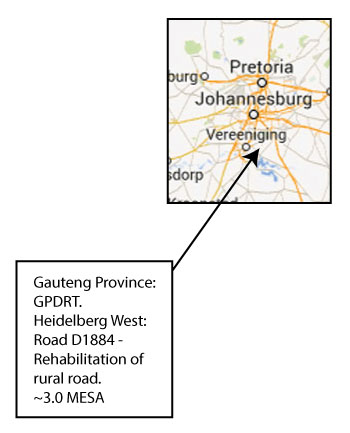
The design traffic loading over a 20 year period for this road would be in the order of 3 million standard 8 ton axels. The challenge was that primary distress was in the existing base and subbase layers. The existing base now classified as a G8 quality material and the subbase now classified as a G7 quality material in terms of Technical Recommendations for Highways (TRH 14.). The challenge was to rehabilitate the road pavement in a cost effective manner.
The solution was to reuse the existing materials, which would typically be considered of marginal to unacceptable quality for reuse within the upper (base and subbase) road layers. Both the base and subbase layers were stabilised with 0,7% GE-Nano, a nano-modified emulsion (NME) containing nano-polymers for strength and nano-silanes for improved water resistance. The rehabilitated pavement therefore comprised two 150mm thick NME stabilised layers with a double seal surfacing.
A portion of this rehabilitated road was then used as a test section for the accelerated HVS testing.
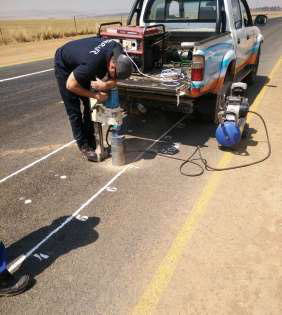
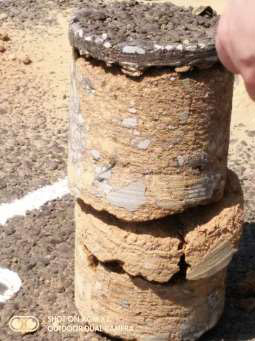
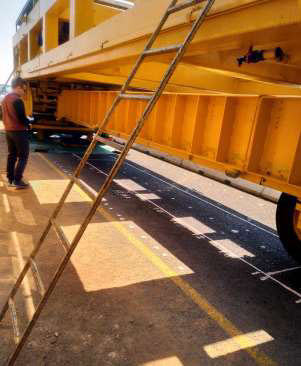
HVS testing was stopped after applying in excess of 7 million standard 8 ton axel loads with less than 10mm of rut depth being recorded and with no failure of either the base or subbase layers.
Water was added continuously to the HVS section to a depth of 500mm during simulated traffic loading from December 2018 until the end of the testing on 17 January 2019. No water penetrated the base or subbase and the water had no visible effect on the behaviour/performance of the road under the simulated HVS traffic loading.
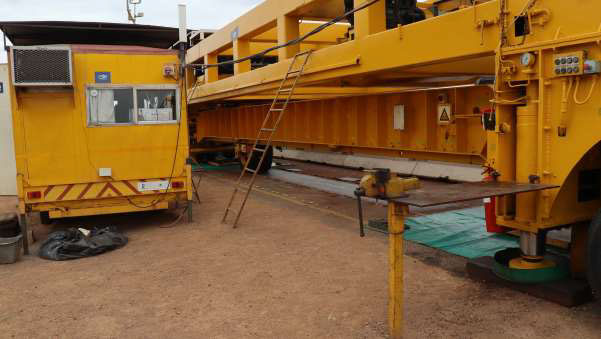
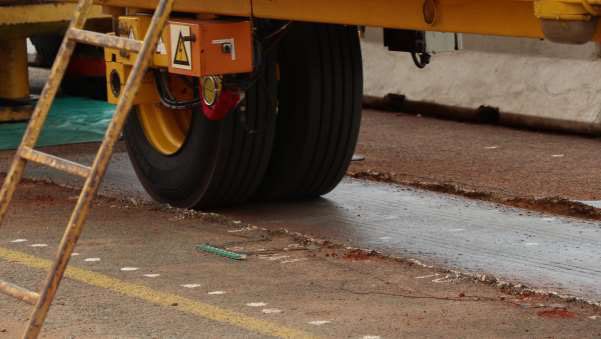
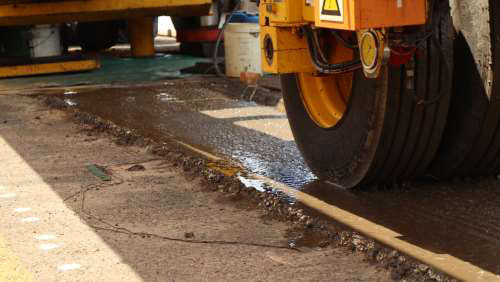
This is a very exciting result for us, since the rehabilitation design was initially cost-effective as the existing road materials were reused and there is scope to make design even more cost effective in future given the excellent performance of the road under accellerated HVS testing even under saturated conditions.
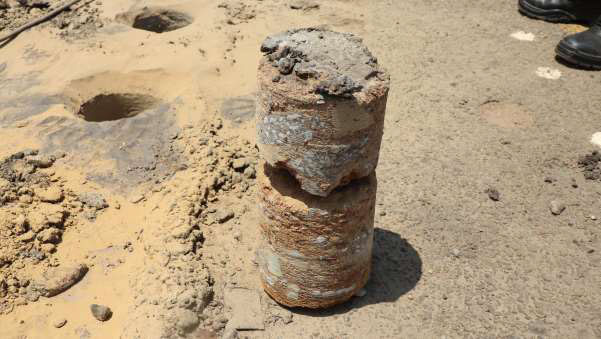
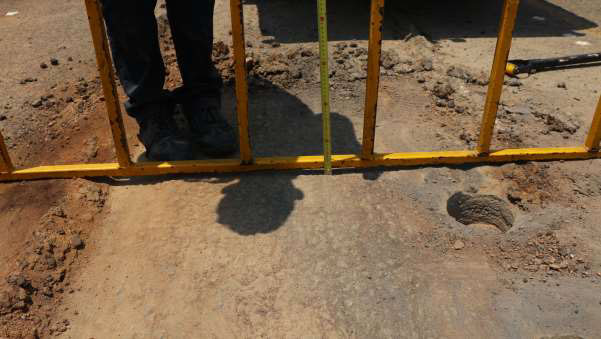
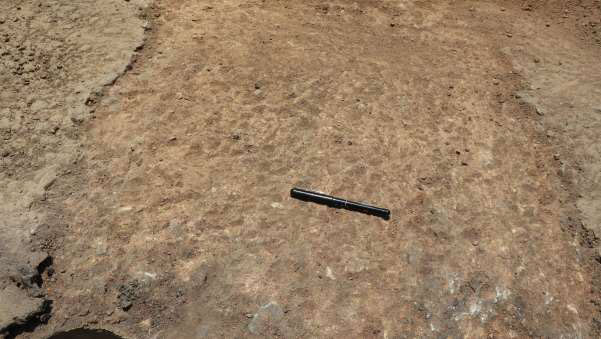
Section 2 North bound lane: Material Properties
| Base-layer | Sub-base layer | Upper selected | ||
|---|---|---|---|---|
| 2018 | 2018 | 2018 | ||
| 15/01/2018 | 14/03/2018 | 14/03/2018 | ||
| Mix Design | ||||
| 0 - 170 | ||||
| Atterberg Limits | LL% | 24 | 23 | 21 |
| PI | 7 | 4 | 3 | |
| LS% | 3.5 | 2.1 | 1.4 | |
| GM | 2.09 | 1.85 | 1.10 | |
| mod-AAHTO | OMC% | 7.2 | 11.4 | 9.1 |
| MDD | 2170 | 2030 | 1967 | |
| CBR | Comp MC | 7.0 | 11.2 | 8.8 |
| % Swell | 0.16 | 0.29 | 0.52 | |
| CBR @ Density | 100% | 27 | 32 | 20 |
| 98% | 22 | 28 | 15 | |
| 97% | 19 | 26 | 13 | |
| 95% | 15 | 23 | 9 | |
| 93% | 12 | 20 | 7 | |
| 90% | 9 | 16 | 4 | |
| Classification | TRH14 | G8 | G7 | G10 |
| Base | Sub-base | Sub-grade | ||
| Pavement Design: | Compacted to 93% mod AASHTO | |||
| 150mm | 150mm | |||
| NME4 | NME4 | |||
| Surfacing: | 20/7 Double seal |