Engen Service Station Tugela 1-Stop N3 North & South
Project Description
Tugela 1 Stop service station is located approximately 3.5km east of the Tugela Toll Plaza on the N3 near Ladysmith in KwaZulu-Natal. Engen, as the owners of the north and south bound service stations, decided to demolish the existing facilities and to re-build the service stations to the latest Engen standards. The project scope included the rehabilitation of the truck stop parking area, the extent of which is approximately 6,800m2 for each site.
Although the truck parking area was constructed to accommodate heavy vehicles, the pavement structure has by now reached the end of its design life and is showing various degrees of pavement failures resulting in potholes and breaking up of the asphalt surfacing.
Geotechnical Information
The existing pavement layers were inconsistent across the site but generally comprised:
- Asphalt surfacing of various thickness (20mm to 40mm)
- Crushed stone base of G1 to G2 quality (110mm to 160mm)
- Sandy gravel sub-base of G5 to G6 quality (150mm)
- Clayey sandy gravel selected layer of G7 quality (120m to 170mm)
- Clayey gravelly sand fill of G8 to G9 quality (various depths up to 600mm)
No rutting and localised settlement was observed over the entire parking area hence indicating that the lower pavement layers were still intact.
Pavement Design
The client’s brief called for a long lasting and maintenance friendly surfacing of the trucking area. Asphalt, concrete blocks and concrete surfacing options were explored and eventually the client decided to use concrete surfacing as his preferred option.
Based on the insitu materials investigations and the fact that all new layer works material would have to be imported at substantial costs it was decided to investigate the modification of the existing layer works.
The existing materials that were to be used for the modified base mixed with NME were tested in the laboratory and the results were extremely encouraging as shown below:
Max Dry Density: 2370 kg/m3
Optimum Moisture Content (OMC): 6,3%
Stabiliser: 1% GE-NANO (+5)
Mix Design Results (Compared to NME1 Specification)
Unconfined Compressive Strength (UCS)
Dry: 3,6MPa > 2,5MPa
Wet: 3,1MPa
Strength Retention: 86%
Penetration: 1-2mm = 1,5mm
Indirect Tensile Strength (ITS)
Dry: 189kPa > 175kPa
Wet: 154kPa > 140kPa
Strength Retention: 81% > 80%
Classification: NME1
The analysis of the test results showed that the strength of the modified layers is equivalent to type NME1 pavement. Based on the very positive testing the following pavement design was adopted:
- 180mm fibre reinforced concrete.
- 150mm NME modified base layer using existing asphalt and G2 material mixed together.
Construction
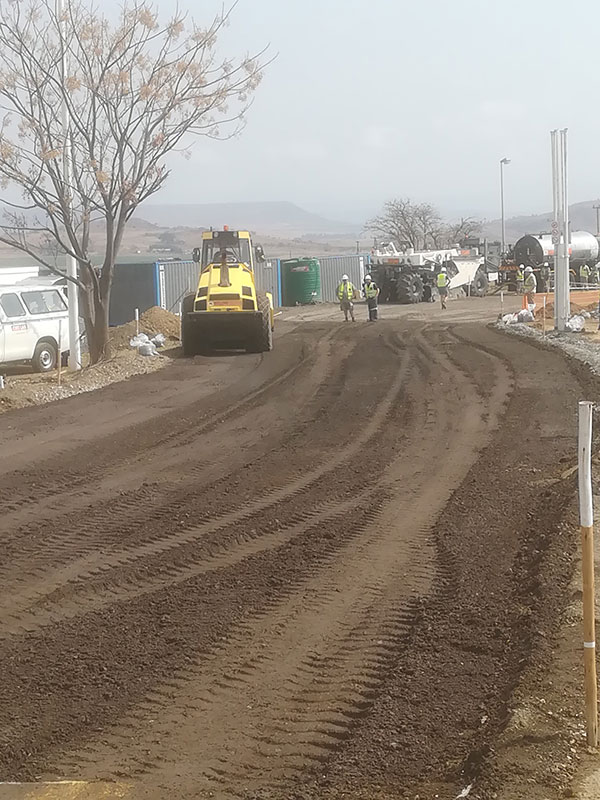
One of the big advantages of NME is the speed at which the base course modification can be done by using a recycler. The entire area of approximately 6,800m2 was milled, mixed with NME, placed, shaped and compacted in one week. Compacted areas can be travelled on almost immediately hence allowing the contractor to commence the construction of the concrete surfacing.
A further advantage of using a recycler is the precise control of the applicable dosage of the NME in the mix.
Completed Project
The completed NME modified base course complied with the design specifications with regards to strength and level control and formed a good solid base for the concrete surfacing. Although sections of the base were exposed to the weather for a considerable amount of time, no negative impacts such as unravelling or softening of material were observed.
Client and contractor expressed their satisfaction with the completed work.